Menu

City College of San Francisco
Jiu-jitsu
Assignments
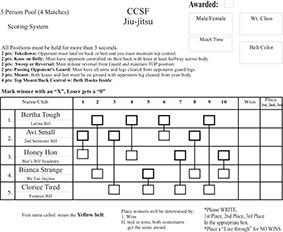
Tournament Management: Using 2 Pool "Fight" Sheets
Tournament Management: Fight Sheet
Fight Sheet
- Pool Method of Elimination
- Pool system of competition will be used: 3, 4, 5, 6, 7, 8 person pool
- Contestants are grouped in pools according to the following criteria
- Sex: Separate grouping for Male and Female
- Belt Color: Similar belt color
- Weight: The contestants are group with a 10 lbs difference between the lightest to heaviest.
- First Name called wears the "Yellow" Belt
- "Yellow" belt is for distinction between contestants for scoreboard.
Jiu-jitsu Syllabus
Hygiene, Etiquette and Safety
Guidelines
Always show respect to your instructors and training partners. Respect in training means: do not seek to harm fellow students physically (e.g., by cranking a submission harder than necessary to make them tap) or emotionally.
Respect also means that you must train seriously and hard enough for you and your partner to improve his or her skills, conditioning, and fighting spirit.
- Stand, sit with your legs crossed, or kneel during class.
- Keep cell phones off during class. Again, they distract those who are trying to learn.
Personal Hygiene
Personal hygiene is a must in the dojo.
- Bring a clean, dry gi to each class. You can always use a rash guard or T-shirt while you workout.
- Fingernails and toenails should always be trimmed short
- All sharp jewelry should be removed prior to practice
- Long hair should be tied back out of the way (braids or pigtails preferably)
- Deodorant can be used prior to practice, but strong cologne should not.
- Bandage all cuts and scrapes prior to practice
- Bring a towel with you and use it rather than your uniform or constantly dripping sweat onto your partner and the mats
- Do not wear heavy makeup as it will smear onto the uniforms worn by you and your partner
Dojo hygiene
Is the responsibility of the dojo members
- Keep shoes off the mat, so that we can keep the mats clean and sanitary.
- Do not walk outside with bare feet. If you have to go outside, wear sandals or shoes.
- Pick up after yourself. Throw you trash in the trash cans.
- if you see trash that is not yours, pick it up and throw it away anyway.
- if there are any blood spills, use the disinfectant to clean it up immediately. (if it’s your blood and you are capable of cleaning it, please do so)
History of Brazilian Jiu-jitsu
History of Brazilian Jiu-jitsu
Many people are likely to conclude that jiu-jitsu originated in Brazil as this martial art is frequently referred to as Brazilian Jiu-Jitsu.
 Although Brazilian Jiu-Jitsu has become popular due to its exposure through mixed martial art, it is heavily influenced and originates from traditional jiu-jitsu as practiced many centuries ago.
As with other martial arts, the origins of traditional jiu-jitsu are marred with lack of genuine historical evidence. Some of jiu-jitsu techniques have been traced back to India, as practiced by Buddhist Monks, and this art is believed to have spread from Southeast Asia (India) to China and finally arriving in Japan. It was in Japan that jiu-jitsu flourished as it evolved through centuries of warfare and civil unrest.
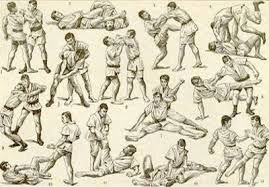 Japan lacked central government and despite current imperial family establishing itself as the ruling party from 700 to 1600s, the political power was divided among hundreds of domains ruled by “daimyo” (lords). Each lord protected his domain with a local army known as the Samurai, Japanese warrior, which trained in various ryus (schools) that specialized in different aspects of self-defense such, as striking, throwing, ground grappling, sword fighting and others.
Through numerous battles, the samurai perfected the art of jiu-jitsu and focused on deadly techniques that were effective in the battlefield. The need for samurais increased exponentially as the lords vied for more land, power, and influence, and the samurai class continued to prospere as the payment for their services was through gifts and land.
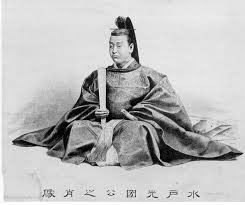 From 1600s and through 1850s, the emperor Ieyasu Tokugawa united Japan by giving land to his supporters and Japan experienced a prosperous and peaceful period as it embraced feudalism and barricaded itself away from the rest of the world. In 1860s, Japan opened its gates and ports to outside world and went through a restoration period under the emperor Meiji as he decided to westernize Japan in order to catch up with the rest of the world. To establish his rule and eliminate the threat of samurai class, the emperor Meiji published an edict which outlawed the practice of old martial arts.
The modernization replaced the feudalism and undercut the need for jiu-jitsu.
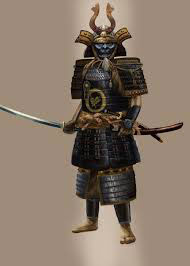 The samurai were no longer allowed to carry weapons and practice their art as Japan now had an army that served the emperor of Japan. With the demise of the samurai and massive sociological changes that swept through Japan, jiu-jitsu was in a serious decline.
Many of the masters had to make a living by becoming physical therapist and participating in show matches while others chose to move to countryside away from watchful eyes of the government in order to continue the practice of jiu-jitsu.
 Jigoro Kano (1860-1938) enrolled in the study of jiu-jitsu to improve a weak physique and to improve own health. After dedicating himself in the study, he became very proficient in two styles of jiu-jitsu, Kito-ryu which specialized in throwing techniques and Tenjin Shin’yo ryu, which specialized in ground grappling techniques.
Through his studies, Kano saw several problems with jiu-jitsu, such as public perception of the art and teaching methods. The public viewed jiu-jitsu as violent and archaic and general public was reluctant to participate in this art due to dangerous techniques that could kill or maim. Also, teaching of Jiu-jitsu was done by kata –prearranged, choreographed sequences in which two partners followed a pattern of movements without resistance. Kano realized that the teaching and training methods lacked “live” or real-life aspect to make it effective.
In 1882, Kano opened his own school, the Kodokan,
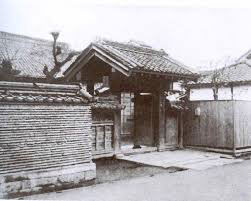 and started a martial art which he named judo, “the gentle way”. In order to make the art effective, attractive, and friendly to the public, Kano decided to eliminate dangerous techniques as taught by traditional jiu-jitsu and added “live” aspect of training which he named “randori”. The main principle of randori is for two students to train “live” with each other while each is trying to apply the technique on the other. This allowed for students to experiment applying a technique on another live resisting human and to sharpen physical and mental agility by experiencing unpredictable movement of real life combat. To avoid attrition through injuries, Kano removed strikes during randori and limited joint locks to elbows.
The Kodokan attracted many talented students and quickly rose to popularity through Japan. In 1886, Tokyo police force was looking for an effective martial art to use in its training and various schools of traditional jiu-jitsu entered a tournament to determine which was going to be chosen to train the police force. Victory was to be determined by having an opponent land on his back or by submission. Due to judo’s focus on throwing and randori sessions, the Kodokan had decisively won the tourney by winning nearly all matches. This result was a deadly blow to traditional jiu-jitsu and judo rose to prominence throughout the world and become an Olympic sport in 1964.
Sensei Jigoro Kano produced many excellent judokas which helped spread judo throughout the world and Mitsuyo Maeda (1878-1941) was one of them.
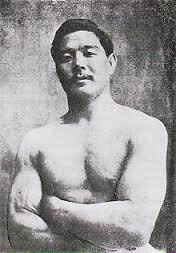 Meada trained in traditional jujitsu and converted to Kodakan judo at the age of eighteen where he was well known for his ground grappling skills. In order to spread judo through eastern United States, Kano sent a delegation along with Maeda and Tomita, an older sensei that participated in Tokyo police tournament. Upon arrival at West point in 1904, the delegation put on a demonstration and Maeda was promptly challenger by an All-American center and champion wrestler, Cadet Tipton. Maeda naturally accepted and was taken down and was “pinned” down for a few seconds on his back as he position to apply the arm bar.
In western culture, being pinned down meant victory but Maeda continued to maneuver for arm lock and forced his opponent to submit. This caused a lot of confusion as to who in fact won the match and the public wanted another match. Since Tomita was higher rank than Maeda, he was promptly challenged to a match and as demanded by his sense of honor, he accepted despite being past his primefighting days. Tomita was subsequently pinned and could only squirm under much stronger wrestler. This was a humiliating loss to the Japanese delegation and Maeda, unhappy with Tomita accepting the challenge, split from the delegation and continued his trek down East Coast towards Brazil.
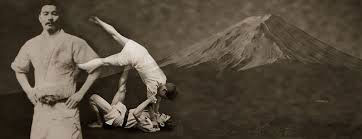 Maeda’s reputation and skill gained in popularity as he continued to enter no-rules fights and even challenged boxing heavyweights of that time, Jack Johnson. As he continued to enter fights, Maeda started to utilize techniques that were not allowed in judo and continued to innovate his styles to deal with wrestlers and boxers by taking the fight to the ground. He won matches throughout Europe and even instilled interest in judo when he stopped over in Cuba.
In 1920s, he continued to travel to Brazil for exhibition matches and it resulted in opening up a judo school in Brazil. Although there is debate as to how the meeting occurred; Maeda met Gastao Gracie, a successful local businessman.
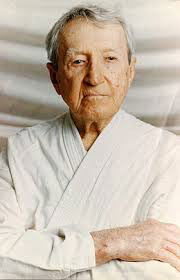 Gastao was concerned about his son, Carlos Gracie, who lacked discipline and enrolled him in Maeda’s judo school. Shortly after, Carlos’s brothers, Helio, Gastao, George, and Oswaldo, enrolled in Maeda’s school and trained with Carlos. Maeda taught them judo and focused on newaza, ground grappling, due to small stature of Gracie brothers. The brothers quickly become proficient in ground grappling by utilizing their agility to submit much larger opponents. One advantage that Gracie brothers had was numbers. Since all were involved in training, there was never a lack of training partners and as they all had huge number of children that followed in their footsteps and continued to grow the family trade. In 1925, Carlos Gracie opened his own school and Gracie family soon became a research team whose field of expertise was ground grappling. They continue to innovate and refine technique and build upon what was imprinted on them by Maeda.
 Following in Maeda’s footsteps, they entered challenge matches and MMA events and quickly gained success and popularity as many of their challengers were not familiar with ground grappling. To differentiate their art from judo, Gracies allowed many of the techniques that had been banned by Kano such as, leg locks, neck cranks, wrist locks, shoulder locks, and others. One of the innovations that Gracies adopted to make their art successful was incorporation of the point system. By training and competing under the point system, Gracies were able to organize grappling competitions and make their art more realistic and applicable to real life situations.
 Gracies referred to their art as Gracie Jiujitsu, interchangeably referred to as Brazilian Jiu Jitsu, and gained popularity in early 1990s when Royce Gracie entered and left his mark on MMA world. Royce became famous for beating opponents much larger than him by taking them to the ground and submitting them. This quickly revolutionized mixed martial arts world as more MMA fighters started to cross train and incorporate Brazilian Jiu Jitsu into their training regimen.
How to score a Jiu-jitsu match
Bouts will be decided by:
- SUBMISSION
- POINTS
- ADVANTAGES
- DISQUALIFICATION
1. SUBMISSION
Submission occurs when a technique forces the athlete into admitting defeat by:
- Tapping with the palm against his opponent or the floor in a visible manner.
- Tapping with his feet on the ground (if he is unable to use his hands).
- Requesting verbally to the referee that the fight be stopped (if he can neither tap with his hands or his feet).
- The referee may end the fight giving victory to the one who applied the lock if he sees his opponent is exposed to serious physical damage.
- A coach of one of the athletes may request that the fight be ended either by directing himself to the referee or by throwing the towel into the ring for any reason
- The referee may end the fight when one of the athletes is injured or the doctor's examination proves he is incapable to continue. If this occurs, the victory will be given to the opponent as long as the injury was not caused intentionally by conduct worthy of disqualification.
2. POINTS
Points are awarded when athlete achieves a strategic superior position over the opponent through performing proper technique. The more dominant the position, the more points are awarded.
- Takedowns
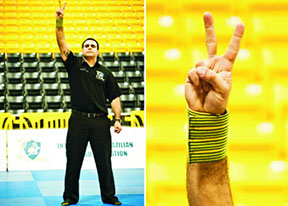
Any kind of throw or takedown where opponent lands on his/her side or back – 2 POINTS
- Passing the Guard
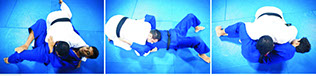
Is when the athlete who is top, in between the opponent's legs, moves to his side, establishing a perpendicular or longitudinal position over his adversary's torso, controlling and leaving him no space to move or escape the hold - 3 POINTS
NOTE: It is necessary to establish this move for 3 or more seconds to receive the points. If opponent escapes, an advantage will be given instead.
- Knee in the Belly

When the athlete on top places their knee and shin across the opponent's stomach, holding their collar/sleeve and belt/pants with their other leg towards the head - 2 POINTS.
NOTE: It is necessary to establish this move for 3 or more seconds to get the points. If opponent escapes, an advantage will be given instead.
- The Mount
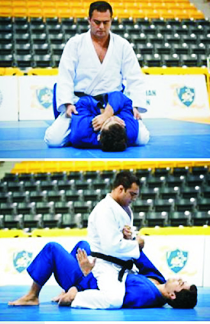 The mount position is one of the most dominant positions in a match or fight.
It is achieved when the athlete sits on their opponent's torso; the opponent may be lying on their stomach, side or back.
It will also be considered mount, if one knee and one foot are on the ground - 4 POINTS.
- Taking the Back
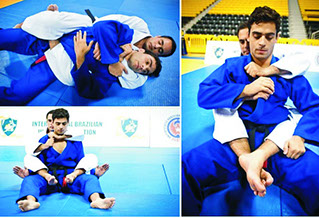
Achieving and controlling the opponent's back is highly advantageous on the way to finish the fight. The athlete takes the back from a bottom position, taking hold of the neck and wrapping his legs around the waist. The heels must be leaning on the inside of the thighs, not allowing him/her to escape - 4 POINTS.
NOTE: Points will not be awarded if both heels are not evenly positioned in the inner part of the adversary's thighs.
- The Sweep
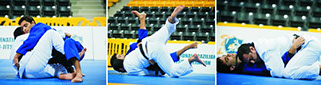
Sweeps are strategically executed to reverse the opponent to the bottom position in a way where he/she is unable to defend or post - 2 POINTS.
NOTE 1: It will not be considered a sweep if the move does not begin from inside the guard or half guard.
NOTE 2: When the athlete sweeping advances their position to the back of their opponent during the attempted sweep, they are awarded 2 points
In case the match ends up tied on points as well, the athlete with most advantages will win.
3. ADVANTAGES
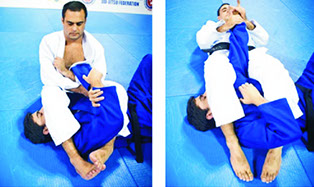
It is considered an advantage when the athlete almost completes a move on your opponent, such as sweeps (opponent bounces back to the top), takedowns (visible loss of balance in which the adversary nearly completes the takedown), guard pass (when forcing the adversary to exert energy to regain position), submissions (forcing opponent to defend), etc...
In case of a tie in advantages, the referee will decide the winner after the following criteria:
- Effort to finish the match
- Aggressiveness
- Positioning control
4. DISQUALIFICATION
The following are considered unacceptable and will lead to immediate disqualification by the referee:
- Use of foul language, cursing, or any other immoral acts of disrespect towards the referee or any of the assisting public.
- Biting, hair pulling, intentionally placing fingers on eyes, nose or mouth, intentionally seeking to injure genitalia or the use of fists, feet, knees, elbows, or heads with the intention to hurt or gain unfair advantage.
- Running out of the mat area when put on a submission hold.
Penalties
- On the first offence the offender will be given a verbal warning.
- On the second offence the offender's opponent will be given an advantage.
- On the third offence the offender's opponent will be given two points.
- After the third offence the referee may disqualify the athlete for any further fouls.
Hygiene
- The kimono must be washed and dried with no unpleasant odors.
- Toe and fingernails must be cut short and clean.
- Competitors with long hair must keep it from interfering with the opponent or themselves during the match.
Referee Hand Signals
CCSF Jiu-jitsu
Referee Hand Signals
Call Athletes to the Mat
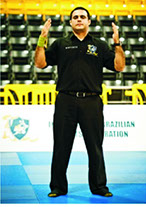
GESTURE:
Arms raised to shoulder height and bent at 90-degree angle with palms of hands facing inwards, motioning by extending arms and returning to initial position.
Start of a Match
Verbal Command: "Com bate" (com-ba -tchee)
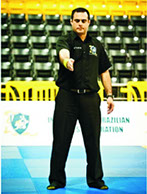
GESTURE: Arm extended forward and then lowered to point vertically toward the ground
Match Stoppage, End of Match, and Timeout
Verbal Command: "Parou" (pa-row)
Penalty
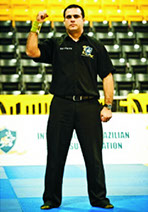
GESTURE:
Arm corresponding with penalized athlete being raised to shoulder height with clenched fist.
Lute (lu-tchee)
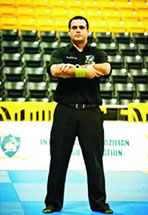
GESTURE:
Elbows pointing outward at chest height with hands holding forearms
MATCH CIRCUMSTANCES:
Penalty for lack of combativeness (stalling).
Disqualification
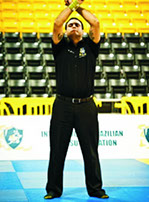
GESTURE:
Arms over head with forearms crossed and fists clenched, followed by arm corresponding with disqualified athlete pointing to athlete’s belt.
Point Deduction
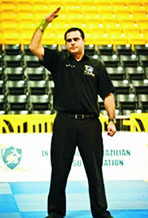
GESTURE:
Arm corresponding with athlete to be deducted points at shoulder height with palm open.
Caution athlete to remain within match area
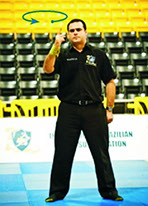
GESTURE:
After pointing to the athlete with arms extended towards his/her waist, hand at shoulder height with open palms making a circular motion.
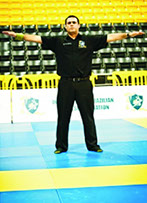
Advantage
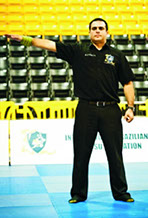
GESTURE:
Arm corresponding with athlete to be awarded advantage point extending parallel to mat with hand open and palm facing downwards.
Fix the Uniform
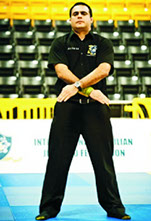
GESTURE:
Arms crossed downwards at waist height, extending arm to indicate athlete’s belt.
Stand Up
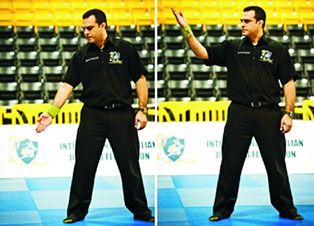
GESTURE:
Indicate with extended arm the athlete who must stand up, followed by raising arm to shoulder height.
Return to Ground in Position
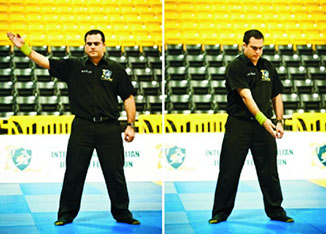
GESTURE:
Arm corresponding with athlete extended to shoulder height, followed by arm pointing diagonally across body toward ground.
Tournament Management: Timer/Scoreboard ID
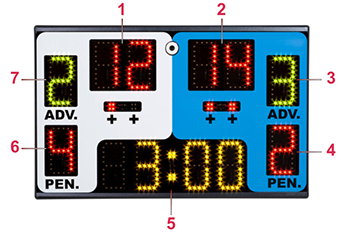
Front of Jiu-jitsu Scoreboard
- Score for "White" Contestant
- Score for "Blue" Contestant
- Advantage point given by Referee
- Penalty point given by Referee to "Blue" contestant
- Match time
- Penalty point given by Referee to "White" contestant
- Advantage point given by Referee
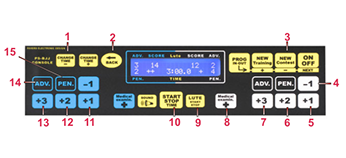
Front of Jiu-jitsu Scoreboard
- To add or minus minutes to timer
- "Back" button - undo previous action
- New contest - reset timer for new match
- Minus - one point to "White" contestant
- Plus - one point to "White" contestant
- Plus - two points to "White" contestant
- Plus - three points to "White" contestant
- Medical time out
- "Lute" - stalling penalty
- Start/stop timer "Combate/start" "Parou/stop"
- Plus - one point to "Blue" contestant
- Plus - two points to "Blue" contestant
- Plus - three points to "Blue" contestant
- Advantage point - "Blue" contestant
- Penalty point - "Blue" contestant